If you search for “innovation,” you’ll find countless definitions. However, innovation has evolved from a buzzword into a fundamental driver of industrial transformation, particularly with the rise of blockchain in real estate, which is reshaping how assets are owned, verified, and transacted.
Every industry evolves around innovation, and the real estate app development is no different. From a dating platform to home-buying tools, every industry is transforming.
The rapid, bold shift is being fueled by emerging digital-age technologies, such as blockchain. What used to be a long, complex process involving brokers, contracts, and title verifications is now a digital-first, trust-based reform.
Blockchain in real estate is at the forefront of this change by making ownership easier, accelerating deal completion, and removing unnecessary layers from the process.
With every step in property transactions, there is increased transparency and security, and in blockchain-based real estate, there is a vision for the future of buying, selling, and investing.
How Blockchain Works in a Real Estate App?
To illustrate the power of blockchain in real estate, imagine a digital ledger that refuses to lie. The details of the property, its owners, and its history, transactions, and contracts are stored in immutable blocks.
This transparency in the system is a powerful tool for reducing fraud and eliminating the guesswork and arguments that are in traditional real estate deals.
The real estate mobile app with blockchain support enables smart contracts. These contracts automatically verify ownership, process payments, and update real estate records without intermediaries, and do so more effectively.
So, how is blockchain used in real estate?
Regulatory systems and blockchain technology in real estate can be aligned to create a more seamless, efficient way to conduct real estate transactions, and all transactions in general, more effectively.
Benefits of Blockchain Technology in Real Estate
Across the latest real estate tech trends, one thing is clear: every user needs safe, fast, and clean transactions. That’s why blockchain is relevant in real estate software development.
Top Benefits of Blockchain in Real Estate
- Unmatched Transparency: One of the key benefits of using blockchain in real estate software is the level of transparency it provides. Moreover, with digital records, it ensures every detail is visible, verifiable, and trustworthy.
- Reduced Fraud Risks: With the help of blockchain, real estate data cannot be altered, forged ownership documents and manipulated records become nearly impossible to create.
- Automated Agreements with Smart Contracts: No more endless legal back-and-forth, conditions execute automatically once met.
- Faster Closing & Settlement Times: With no more endless legal conditions, executed automatically once met.
- Lower Administrative & Operational Costs: Automation reduces paperwork, middlemen, and repetitive processes.
If trust is the real currency of real estate, then blockchain is the mint producing it at scale, delivering a system where transparency, speed, and security are built in.
Blockchain Applications in Real Estate
Before learning how to build a real estate app, it is essential to understand where blockchain tech app fits in.
It puts the entirety of property data storage, verification, and data exchange into a new paradigm. And it makes each step, from verifying buyers to updating land registries and everything else in the property transaction process, faster and more secure.
Smart contracts eliminate traditional paperwork bottlenecks by automating modular payments at each transaction milestone. They securely release funds, execute escrow conditions, and transfer property titles through automated, tamper-proof systems, ensuring an accurate and third-party-free shift of ownership.
By streamlining processes such as rental agreements, lease management, escrow handling, and title transfers, real estate blockchain solutions create immutable property histories that reduce errors and disputes. These capabilities are redefining blockchain in real estate transactions, delivering faster settlements, higher transparency, and stronger trust.
To be clear, blockchain applications in real estate are no longer experimental innovations. They represent the foundation of a new industry paradigm, one built on automation, security, and decentralized trust.
Real Estate Tokenization with Blockchain
Consider the ease of purchasing a premium share rather than buying an entire property. Real estate tokenization, the ability to turn real estate assets into a digital token, captures the essence of blockchain real estate.
Real estate is becoming more accessible and no longer limited by the need for significant upfront capital. Barriers to entry are breaking down, capital is becoming more liquid, and global participation is now seamless. These shifts are being driven by blockchain in real estate, which enables fractional ownership and transparent asset management.
Web3 real estate apps will allow end-to-end tracking of property assets, including token issuance, digital wallets, regulatory compliance, and investor dashboards. In real estate, blockchain-enabled tokenized assets ensure secure ownership, prevent unauthorized transfers, and eliminate opacity that often leads to fraud or asset theft.
Real estate is one of the last assets to benefit from such a transformation. Tokenization democratizes real estate, enabling access to previously exclusive elite circles.
Blockchain in Commercial Real Estate
Commercial real estate moves at a rapid pace, encompassing leasing, compliance, asset management, tenant onboarding, and audits, often creating operational complexity.
Blockchain in commercial real estate streamlines these processes through secure, fully vetted automation, ensuring consistency, transparency, and efficiency.
By enabling innovative leasing models and fractionalized investments, blockchain-driven platforms create a data-driven advantage for commercial properties, improving operational control while unlocking new revenue and investment opportunities.
Furthermore, integrating real estate app workflows with blockchain and generative AI can enable next-generation systems. Imagine being able to draft a lease, identify and analyze market risks, and predict shifts in a property’s value.
Generative AI in a real estate app can do all of these, while blockchain technology will keep all the data in a secure, immutable, and transparent system. This will enable future frictionless systems to help transform the process of modernizing commercial real estate.
This technology unlocks new potential for transparency, operational efficiency, and democratized global investment, positioning blockchain in commercial real estate as a transformative force for the industry’s future.
Top Real Estate Blockchain Use Cases in 2026
As the real estate industry accelerates through its digital transformation, blockchain-based use cases are emerging at an unprecedented pace.
By 2026, the next wave of mobile app innovation will focus on real-time ownership verification and smart contract–driven automation, ensuring that property transactions are executed securely and recorded directly on decentralized ledgers.
These advancements highlight the benefits of blockchain in real estate, including reduced fraud, faster escrow processing, enhanced transparency, and immutable ownership records.
Land registry systems already leveraging blockchain to prevent fraud are now moving toward fully automated escrow workflows, setting a new standard for trust and efficiency across the industry.
The digital tokenization of real estate has enabled borderless investments, and blockchain technology is being incorporated in rental platforms to facilitate seamless tenant identity verification and electronic lease agreements.
Even public agencies are utilizing blockchain technology to create systems for efficient and transparent administration of property taxation.
The result? Real estate transactions will occur at the pace and speed users demand.
How to Use Blockchain in Real Estate Apps?
If you’re wondering how to incorporate blockchain technology into real estate, the process is more strategic than complicated, akin to enhancing an app from ‘smart’ to ‘genius’.
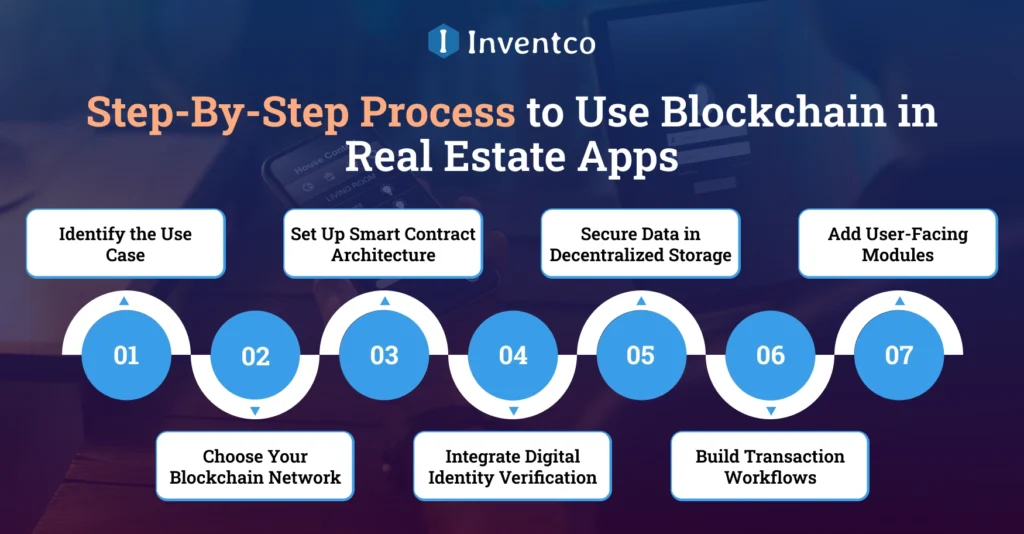
Here is the step-by-step process to use blockchain in real estate apps:
Step 1: Identify the Use Case
When creating a real estate app, set a primary goal, such as title management, tokenization, ownership verification, fraud mitigation, or transaction automation.
This will lay the foundation for required features, workflows, and blockchain integrations to enable effective operations in real estate.
Step 2: Choose Your Blockchain Network
Based on the app’s goals, select a suitable blockchain or public network, such as Ethereum or Polygon, that provides the desired level of transparency.
If greater privacy is needed, private blockchains provide compliance, security, and control over network accessibility.
Step 3: Set Up Smart Contract Architecture
This step in the blockchain real estate app development is to design smart contracts to automate agreements, rent cycles, payments, verifications, and other conditional processes.
This ensures no manual engagement in critical real estate transactions while maintaining ideal workflows.
Step 4: Integrate Digital Identity Verification
Now, in this part of the process, add mobile app security, such as digital identity verification, to support KYC and AML checks. It ensures buyers, investors, and renters are authenticated before they view any agreements or property listings.
Step 5: Secure Data in Decentralized Storage
To prevent real estate information from being edited, introduce a transparent, immutable, decentralized, and secure data system with a verifiable trail of records, property documents, and transaction histories, housed in decentralized storage systems.
Step 6: Build Transaction Workflows
Create streamlined automated workflows for listings, setting agreements, payments, transferring ownership, blockchain, and real estate transactions, and ensure they remain fully automated, transparent, traceable, and real-time.
Step 7: Add User-Facing Modules
Integrating user modules such as dashboards, wallets, and document vaults makes it easier for users to access the real estate application. The improvements in interaction transparency and accessibility give the platform a polished, seamless feel.
Using traceable automated transactions globally will enhance your real estate mobile app experience.
Essential Features of a Real Estate Blockchain App
Before creating a blockchain-powered mobile app, it is critical to understand the key features that significantly enhance the user experience.
The real estate solutions built on blockchain hinge on maintaining an unbroken history of ownership records, real estate titles, and proprietary documents.
Automated smart contract tasks further enhance efficiency by releasing payments in real time and eliminating intermediaries.
A digital wallet becomes essential for storing tokenized assets and managing transfers, while a chatbot in real estate can guide users through payments, escrow details, and wallet operations seamlessly.
By adding identity verification to user onboarding, you improve the platform for all accounts, offering buyers a more trustworthy experience.
You reduce the likelihood of fake properties in your ecosystem with mobile app features such as blockchain-based listing verification, and a tamper-proof document storage system reduces the risk of legal disputes.
Market control workflows, analytical dashboards, and real-time valuation analytics are core capabilities of a blockchain in a real estate app, delivering a transparent, fraud-resistant experience for users across modern real estate platforms.
How to Build a Blockchain in a Real Estate App?
Integrating a blockchain in a real estate app has its complexities. Your dedicated developers need to rethink the entire transaction for your mobile app development process, starting with the primary app goal: verifying a property, tokenizing it, leasing it, transferring ownership, or engaging in transactions that cover the entire process.
At this stage, it is essential to finalize the mobile app technology stack, select the appropriate blockchain network, and design the system architecture for smart contracts, wallet integrations, and decentralized cloud infrastructure.
These decisions define the blockchain’s impact on real estate, shaping scalability, security, and long-term platform performance.
Developers must also implement modular systems for property listings, verification, payments, and document repositories, ensuring seamless integration across the entire real estate ecosystem.
Subsequently, the completed application must undergo rigorous mobile app testing to confirm that it aligns with legal requirements and other regulations and meets the desired level of performance and mobile app security.
With the ideal technology stack, the application will become a scalable, transparent, and highly dependable solution for property transactions.
Challenges and Limitations of Blockchain in Real Estate
Even though blockchain technology is transforming the real estate industry, it also has its own set of challenges.
One of the biggest challenges in mobile app development is integrating blockchain without sacrificing performance.
Real estate transactions require the use of unstructured data, and this data must be kept up to date when used with decentralized networks. This can hinder or slow the application’s responsiveness.
Differing regional approaches to digital ownership, tokenization, and smart contracts create regulatory uncertainty, further complicating the development of customized architectures that meet scalability, compliance, and data privacy requirements.
Cost to Develop a Blockchain Real Estate App
“How much will it cost to build a real estate app?” is always the first question businesses ask when considering integrating blockchain technology.
The development cost of blockchain real estate apps depends on several factors, including real estate app features, complexity, regional compliance requirements, and the chosen blockchain network.
If you are looking to build a comprehensive platform that includes smart contracts, tokenization, and KYC-compliant frameworks, the price will be on the higher end. Conversely, property verification apps cost a lot less.
The development cost is also heavily influenced by the location. The U.S. and Europe are much more expensive than Asian countries. Add design, testing, infrastructure, and security layers, and the investment becomes a long-term digital asset.
Nevertheless, due to fraud mitigation, automation, and global scalability, blockchain apps will deliver strong ROI.
Future of Blockchain in Real Estate Transactions
The role of blockchain in real estate transactions is poised to shape the industry’s future.
Blockchain technology is shifting property deals toward a model in which trust is embedded directly in the system, rather than negotiated between parties, resulting in greater transparency, security, and efficiency across every transaction.
Real estate will rely on smart contracts to automate agreements in real time. Ownership will be verified, and global tokenized investing will be as seamless as a QR code.
Government registries are beginning to adopt the blockchain for land records, meaning fraud, fake listings, and title disputes will soon be obsolete.
The integration of blockchain technology and AI into real estate apps will yield more accurate, bias-free pricing models.
The use of blockchain technology will soon become standard, not an optional upgrade, for real estate transactions, and it will continue to inspire innovative real estate app ideas that focus on transparency, security, and trust across every stage of the property lifecycle.
How Inventco Helps You Build a Successful Real Estate Software?
Inventco is the trusted mobile app development company. We blend deep domain expertise with advanced blockchain engineering to build real estate software that truly stands out. Our team designs secure, innovative contract systems, tokenization modules, compliant payment flows, and high-performance architectures tailored to your business vision.
Whether you want a tokenized marketplace, an innovative leasing platform, or a complete Web3-powered ecosystem, we handle everything from planning to deployment, helping you launch a scalable, future-ready real estate solution that users can trust from the start.
Conclusion
A new era of blockchain technology is becoming a tangible reality, and it is the new basis for contemporary real estate transactions.
With the real estate industry pivoting towards greater transparency, automation, and accessibility for a global audience, real estate apps powered by blockchain technology are the new benchmarks for how real estate will be bought, sold, and rented, and for how new real estate investments will be made.
Those who accept and adapt to this change first will experience accelerated market growth, leading to greater consumer trust and new profit streams. The change in the real estate industry is not simply a transformation; it is Ethereum.
FAQ’s
Q1. What is blockchain in real estate?
Ans. Blockchain in real estate refers to the use of decentralized digital ledgers to store property records, automate transactions, verify ownership, and eliminate fraud. It creates a transparent and secure ecosystem for buyers, sellers, and investors.
Q2. How is blockchain used in real estate apps?
Ans. Blockchain powers smart contracts, tokenization, ownership verification, digital identity checks, escrow automation, and tamper-proof property histories—making transactions faster, cleaner, and more trustworthy.
Q3. What are the benefits of blockchain in real estate?
Ans. Benefits include transparency, reduced fraud, faster settlements, automated agreements, traceable property history, and global investment opportunities enabled by tokenization.
Q4. Is blockchain valuable for commercial real estate?
Ans. Absolutely. Blockchain streamlines leasing, compliance, tenant onboarding, audits, rent cycles, and ownership transfers—especially powerful when paired with AI or generative tools.
Q5. What is real estate tokenization?
Ans. Tokenization converts real-world properties into digital tokens that represent fractional ownership—making investing easier, more accessible, and globally scalable.
Q6. How much does it cost to build a blockchain real estate app?
Ans. Costs vary depending on features, complexity, blockchain network, compliance layers, and development region. More advanced features, such as wallets, tokenization, and smart contracts, increase investment.
Q7. Are blockchain real estate apps secure?
Ans. Yes. Blockchain ensures tamper-proof data, encrypted transactions, and immutable records, making it far more secure than traditional real estate systems.

Jitendra Jain
He is the CEO and Co-founder of Inventco, driving innovation in advanced computing and digital transformation. With deep expertise in modern IT ecosystems, he leads scalable, secure, future-ready solutions. His strategic leadership helps businesses accelerate growth, adopt innovation, and achieve success. You can connect with him on LinkedIn to follow his technology insights.

