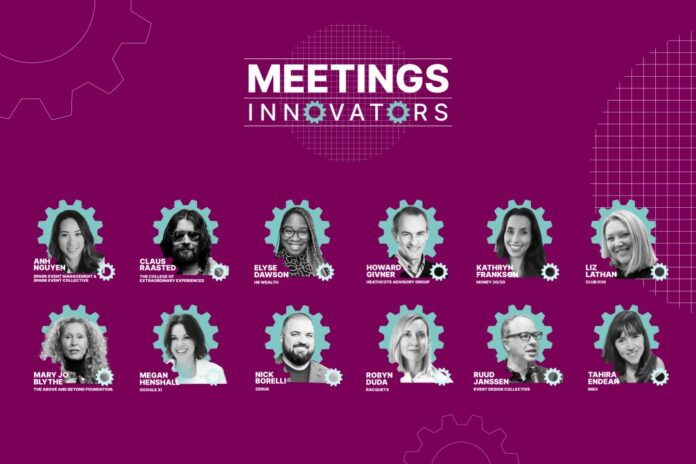
This month’s Skift Meetings Innovator, Nick Borelli, director of marketing at ethical facial analysis company Zenus, believes that fear of failure is one of the biggest roadblocks to innovation.
Innovation is the only means to rise above the chorus of same-same B2B events, he said. “In a world of AI’s scraping of what has been democratically distributed, innovation goes from nice to have to need to have if you’re looking to survive in your market.”
Borelli joins 11 other industry leaders chosen by Skift Meetings’ editors in 2025 to share their views on innovation. Like him, they all believe that innovation requires a level of risk-taking.
For Kathryn Frankson, global director of marketing at Money20/20, it starts with curiosity. “Those with a curious mind question, adapt, and love the process, not just the result. And that ability to see something and question it, react to it, and allow it to spark something in you — that’s what leads to innovation.”
From turning pickleball courts into opening-night venues to measuring success through emotion rather than attendance, Liz Lathan, founder of Club Ichi, is an expert at shifting the paradigm of B2B experiences.
“It takes courage to question why we’re doing things the way we’ve always done them, and then actually doing something about it,” she said. “But at the same time, it’s important to learn the difference between when something needs to change and when you yearn to change it because you got bored with it. Both are valid reasons for change, but understanding your need to innovate helps you advocate for your new ideas.”
Like Lathan, Claus Raasted, director of The College of Extraordinary Experiences and our June Innovator, is on a mission to make meeting organizers “a little less afraid.” He told Skift Meetings: “If you don’t have people who are prepared to do it differently then you’re not going to have innovation. What you’re going to have is incremental improvement.
“But if you want real change, then you need to go to people who say, ‘Let’s try something different.’ And maybe it’s going to fall flat on its face. Maybe it wasn’t such a good idea. But the reaction might also be, ‘Oh, hell, why haven’t we done this before?’”
Breaking Down Barriers to Change
There will always be certain individuals or corporate cultures that try to stand in the way of innovation. November Meetings Innovator Elyse Dawson, senior event manager at HB Wealth, cautions that it’s essential to push past the nay-sayers. “We will always have these people who want to stay where they are. I think ultimately there’s still a large portion of people who are not ready, and some who are willing to try new things.”
She likens it to the move toward paperless meetings. “I remember that the first year we brought in a mobile app, and there were some people who were saying, “Why are we doing this? You can’t just change things like that.’
“But it just took a year, maybe two, to migrate people away from the binders. Now every conference you go to has a mobile app.”
The current budgetary challenges are forcing planners to be more innovative, said our March Innovator, Tahira Endean, head of programming at IMEX, “Costs are up on average 21-36% or more, which requires us to be more innovative to have that impact because we need to edit our decisions. We really need to think about what we can do to maximize the event experience.”
Collaboration Drives Innovation
Ruud Janssen, co-founder, Event Design Collective, believes that innovation is collective and that planners need to be open to collaboration and change.
“Everybody’s convinced about their own kind of drive and their own thing and pushes that. And the more you push it onto others, the harder it is to get buy-in. So, it’s about deconstructing the push and turning it into a pull where people want to become part of something. And then the buy-in process grows naturally. When people feel that ownership because they created it together, you’re already more than halfway there.”
Having a clear strategy is as important as the innovation itself, said Robyn Duda, co-founder and CEO of RacquetX. “Innovation needs clear KPIs, implementation support, and an investment value. Often, an innovation is abandoned because there wasn’t a realistic strategy or team to execute.”
August Innovator Howard Givner, who runs his own consulting company, Heathcote Advisory Group, has successfully built and sold three event businesses and has advised over a dozen others on M&A and growth. He encourages aspiring innovators to find inspiration outside the events industry. “Event professionals should be looking everywhere — hotel and restaurant design, fashion, technology, education, content creation.”
Take Steve Jobs, for example: “It was his fascination with calligraphy that drove him to create a wide range of fonts for the Mac, bringing elegance and style to what was previously a very utilitarian field,” he said.
Skift Meetings’ first-ever Meetings Innovator, Anh Nguyen, founder of Spark Event Management, a full-service event management firm, and the Spark Event Collective, a network of independent planners, offered some valuable advice to would-be innovators: Just buy the domain.
“It’s my way of saying, ‘Just get started.’ Taking a small first step is often all it takes to put an idea into motion,” she said.
“It’s easy to get stuck in analysis, waiting for the perfect timing or for everything to align. But sometimes, you just need to take that leap.”

