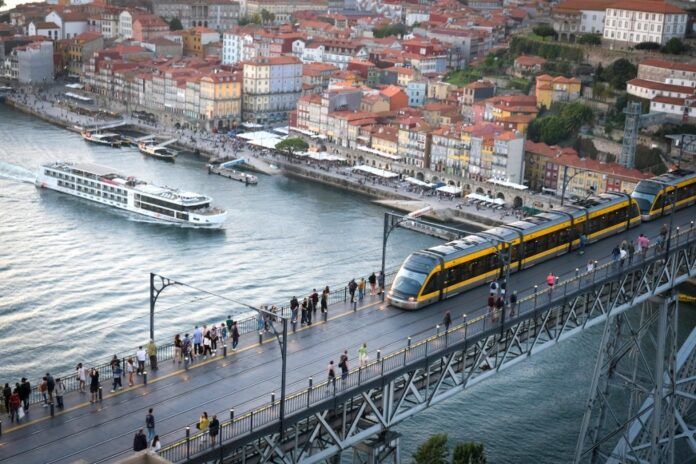
The International Congress and Convention Association (ICCA) gathered 1,500 attendees at its annual meeting in Porto, Portugal, one of the largest ICCA events to date. But Porto lacks a city-center venue with the capacity to accommodate a business event of this size. The workaround: a multi-venue event format using nine venues — five used simultaneously — and multiple vendors, all coordinated in close partnership with the destination.
When Porto first bid for the event it proposed a “normal” single-venue formal. As the event got closer, organizers added venues to be able to adequately accommodate breakouts for 1,500+ attendees. This addition also provided a way for the destination to showcase more of its venues and vendors.
This wasn’t the first time ICCA took risks with its annual meeting by showcasing innovative event formats. In Abu Dhabi last year, it used a flashy circular stage design centered in a convention hall with four smaller themed stages spread out around it. The 2020 and 2021 editions of the event went ahead despite the Covid pandemic using a multi-hub hybrid format, an ambitious and costly format — at the time heralded as the future — that no other industry association attempted on a comparable scale.
New Options for Smaller Destinations
The multi-venue format used in Porto was an opportunity for ICCA to showcase the multi-venue format to its members, and in particular, to nudge smaller destinations to rethink what is possible.
ICCA’s GlobeWatch report released in May highlighted ICCA’s desire to support smaller destinations, using Porto as a case study. “Associations are increasingly turning to second- and third-tier destinations that offer flexibility, accessibility, and stronger local alignment. Porto’s selection as host of the 2025 ICCA Congress reflects this shift, highlighting how smaller cities that think strategically and invest in sustainable competitiveness are rising on the global stage.”
According to Gemmeke de Jongh, ICCA’s senior manager education & impact, using a multi-venue format may be especially appealing for smaller European cities that are “very often a bit stuck with the limit of the main venue.” De Jongh believes that as a result of the event, destinations will feel more confident to submit bids beyond their normal capacity.
Porto’s Appeal
According to Visit Porto and North of Portugal – Convention & Visitors Bureau, the city normally bids events for up to 800 attendees, but using a multi-venue format it could host up to 3,000.
The ICCA Congress 2025 became the ideal test case for the format.
Beyond showcasing the destination, Porto used the event to launch the second “chapter” of its creative marketing campaign using a fictional character, Ofelia de Souza, the city’s wise, luxury-loving aunt who knows about all that’s trendy.
Porto, Portugal’s second-largest city, has consistently hosted between 54 and 71 international association meetings of at least 50 attendees, according to ICCA’s statistics. Last year it reported 59, ranking 34th globally, and 22nd in Europe, above southern European cities with much larger venue capacities, such as Valencia, Naples and Lyon.
Porto has plenty of tourism appeal and offers direct flights to 128 destinations in 31 countries, according to FlightConnections, including multiple daily connections to major European hubs, and direct flights to New York, Boston, Toronto and Montreal.
Limited Hotel and Venue Capacity
However, its hotels are not ideally suited to larger business events. Porto has around 17,000 hotel rooms, according to Christie & Co. Its convention bureau lists 91 hotel members, but according to Cvent, only three hotels offer more than 200 rooms, with the largest topping out at 252 rooms.
Meeting space is also a challenge. Hotels only offer limited meeting space, with only one offering more than 15,000 square feet.
Alfandega Porto Congress Centre — the main venue used by ICCA — is the city’s main venue for business events. The venue is a repurposed customs house sitting on the banks of the Douro river, conveniently just a few minutes walk from the city’s tourism hotspots. It offers 45,000 square feet of event space, with the largest room seating up to 1,200 in theater-style using a narrow stage design. However, the venue has limited options for breakouts, and its layout — adapted from its original use — is anything but linear. Several hotels are within walking distance, but none are large enough to function as a headquarter hotel.
The Multi-Venue Event Format in Practice
ICCA used six separate venues for daytime sessions, with three more for evening events. In total, organizers coordinated nine venues, three catering companies and two audiovisual providers.
Two venues hosted general sessions. The Coliseum of Porto, a music and showbiz venue, was used for the first day only.
During the afternoon breakout sessions on the two middle days, the complexity reached its peak. For the two-hour sessions, four additional venues came into play with venues carefully selected to embody the track themes.
- The Cruise Terminal of the Port of Leixões, a modern and iconic sea port terminal building, hosted the Impact & Sustainability track.
- One of the city’s most famous homes of Port, Ferreira Cellars, hosted the Future Leadership & Resilience track.
- Alfandega Porto Congress Centre was home to the Purposeful Business Models & Startups track.
- CEiiA, a new engineering and product development centre, hosted the Innovation & Technology track.
- WOW (World of Wine), a newly developed multifunction space blending shopping and port wine experiences, hosted the Creative Edge track.
ICCA’s intention was to use only venues within walking distance, to keep it a “walking congress.” But ultimately two venues were deemed so well suited to the track themes that they made the cut, despite being outside the city. Transfers to these venues used electric buses to keep carbon emissions low. One hour gave attendees time to get to the venues, or enjoy a break between sessions.
Stretching Coordination
ICCA’s pre-event communication laid out the concept of the “unique multi-venue format” in social videos and written format, yet in practice attendees still needed ample guidance to connect the dots on site. Helping attendees move between venues on site was even more important for anyone requiring additional assistance, a challenge that any organizer taking on a multi-venue approach must not overlook.
Checking in and badging presented an interesting challenge on the first day. As the general session on the first day was in a different location to the rest of the event, attendees were instructed to go to the main venue to get their badge, as badging facilities were not set up at both venues. For some, this added an unwelcome trip to multiple venues, depending where they were staying and their morning program.
Porto is a small and compact city, but it is also a hilly one with cobblestone sidewalks that are as pretty as they are slippery. While many attendees were happy to walk or take public transport — making use of the free city-transportation cards handed out at registration — the path between venues and the many hotels used was not always practical.
Keeping sessions running on time was even more crucial around the multi-venue portions of the event, to allow for attendees to transfer between venues on time and have enough time for meals and breaks.
There was also a need to keep audiovisual and production standards high. The added complexity of the additional venues, multiple rehearsals, and sound checks to coordinate make this extra challenging.
In theory, the multi-venue format has the potential to add branding and engagement opportunities for sponsors. However, with sessions happening across more, sponsor exposure is diluted, and while physical branding materials can be duplicated it’s hard to justify the extra cost considering attendees will only spend a few hours at some venues.
The additional venues and suppliers gave the host city more opportunities to showcase vendors., and the destination was incredibly active in supporting the event and coordinating with suppliers. However, the need for this level of coordination alone may make planners consider if the extra logistical challenges and costs associated with the multi-venue format are worth it.
The Potential Tourism Upside for Porto
From a tourism perspective, the event proved successful, at least from the many anecdotal conversations with attendees, and the multi-venue format may have played a part in introducing different parts of the city. However, it’s hard to tell whether the venue-hopping had any real impact on the city’s appeal. Would attendees have enjoyed the city less if they had not moved to different venues for the two breakout sessions?
While the multi-venue format can bring more of the destination into the event, this could also be achieved in other ways, for example by giving attendees more free time and recommendations they can explore on their own or in groups.
Sure, the multi-venue approach also had wellbeing benefits, providing a break with a little physical exercise — depending on the transfer style — and more time outside. Luckily the weather cooperated, with periods of Autumn sunshine interspersed with rain showers.
One additional thing to consider is how the dispersion of attendees could have a negative impact on networking opportunities, particularly for the more experienced attendees who often skip content sessions and prefer to meet peers at the main venue. This was less practical during the breakout sessions.
The Real Test
For Porto the real litmus test comes over the next few years. From the around 100 association planners attending, how many will be tempted to take their larger events using a multi-venue format? If it works, Porto will increase the number of large meetings — defined by ICCA as 1,000 attendees or more — it hosts, and this will be reflected in the ICCA rankings.
While the effectiveness of the multi-venue format is up for debate, by trialing this capacity- extending event concept ICCA showed it’s willing to take calculated risks with significant potential upside for its members. “Maybe that’s the way forward, allowing ourselves to do things that maybe nobody dares or can do,” said de Jongh.

