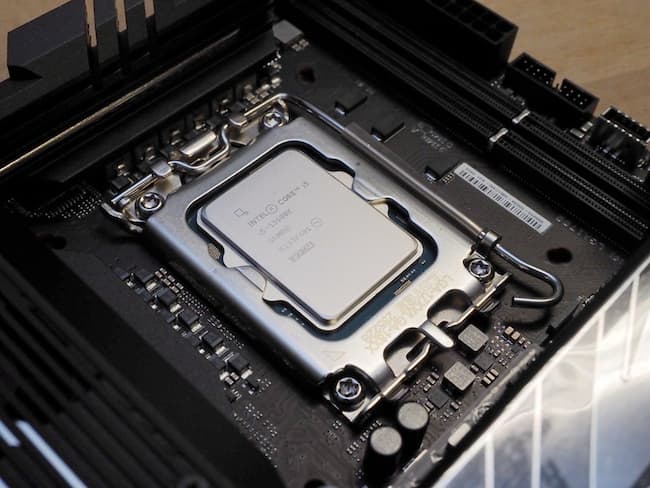
Let’s set the record straight for those who have no idea what Bartlett Lake-S is. We’re talking here about a series of Intel processors dedicated to edge computing and embedded applications. This series is well-documented by the Blues, but its release is still hypothetical. Over the last few hours, we’ve been hearing about it again… But why all the excitement? Quite simply because it would be available on the LGA-1700, the socket that has been limited to Alder Lake and Raptor Lake processors. A solution that would prolong the life of these motherboards while offering a decent and welcome upgrade in the current period. Here’s a table of this potential range, based on data published by our colleague.
| Model | Cores (P+E) | Threads | Max frequency (Boost) | L3 Cache | Estimated TDP* | Remarks |
| Intel Core 9 273PQE | 12 (12+0) | 24 | 5.9 GHz | 36 MB | 125 W | Flagship, very high frequencies. |
| Intel Core 9 273PE | 12 (12+0) | 24 | 5.7 GHz | 36 MB | 65 W | More efficient standard version. |
| Intel Core 9 273PTE | 12 (12+0) | 24 | 5.5 GHz | 36 MB | 45 W | Low-power version. |
| Intel Core 7 253PQE | 10 (10+0) | 20 | 5.7 GHz | 33 MB | 125 W | Single configuration with 10 P cores. |
| Intel Core 7 253PE | 10 (10+0) | 20 | 5.5 GHz | 33 MB | 65 W | Good power/energy compromise. |
| Intel Core 7 253PTE | 10 (10+0) | 20 | 5.4 GHz | 33 MB | 45 W | For chassis with constrained cooling. |
| Intel Core 5 223PE | 8 (8+0)** | 16 | 5.4 GHz | 24 MB | 65 W | High-performance entry-level. |
| Intel Core 5 213PE | 8 (8+0)** | 16 | 5.2 GHz | 24 MB | 65 W | Reduced frequencies for entry-level applications. |
| Intel Core 5 213PTE | 8 (8+0)** | 16 | 5.2 GHz | 24 MB | 45 W | Low-power Core 5 version. |
Intel Bartlett Lake-S: we want to believe it, but…
In contrast to Raptor Lake, these CPUs adopt an architecture based exclusively on P-cores, without E-cores, which also distinguishes them from Arrow Lake processors. They are positioned in the mid-range with, for example, the Core 9 273PQE offering 12 P-cores and 24 threads, with a maximum turbo frequency of 5.9 GHz and a 36 MB L3 cache. As a result, should Intel decide to release this family of processors to the general public, these processors, compatible with socket LGA-1700, could run on 600 and 700 series motherboards via BIOS updates. This solution ensures compatibility with DDR4 and DDR5 memory. A sort of last breath for these tried-and-tested platforms, and one that would help to burnish intel’s image at a time when times are troubled and the Blues have a highly contrasting history when it comes to their socket durability policy…
But for the time being, we’re only talking about these Bartlett Lake-Ss because of a series of potential performance leaks. These leaks allow us (with all due caution) to get an idea of the performance under PassMark, of a Core 7 253PE showing a single-core score of 3,647 points and a multi-core score of 31,802 points, i.e. 20.6% faster than the Core i5-14400 in multi-thread, with an equivalent number of cores. But the arrival of these processors is still very hypothetical, and when we observe the presence of numerous suffixes such as PE, PTE or PQE, we come to wonder about the arrival on the market of references that seem destined for specific uses. In short, a good idea, a good opportunity, but Intel’s position remains as nebulous as ever at this point.

