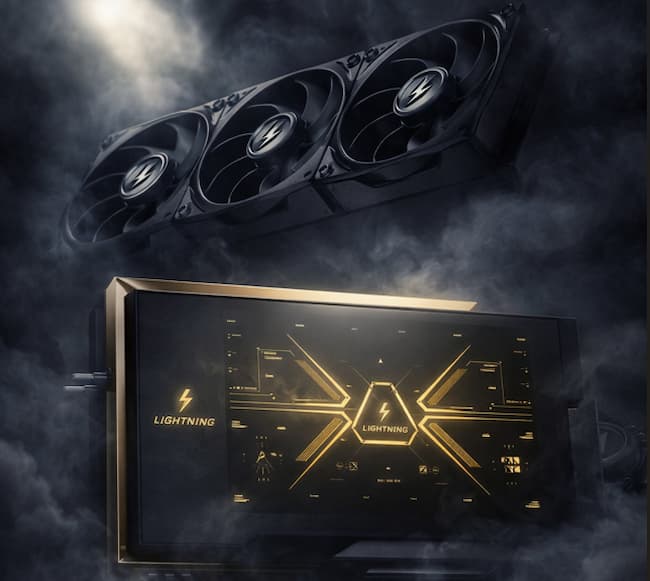
You may have already seen the main details here. MSI has clearly made a big splash by reviving its Lightning range. So, of course, this card, which will go on sale in February in a limited edition of 1,300 units, is going to melt credit cards… But it seems that MSI has enlisted the help of Nvidia to finally give free rein to those who want to take a chance on a graphics card. Is this a way for the Greens to secure some marketing in 2026, when the year is shaping up to be a difficult one?
Unboxing the MSI RTX 5090 Lightning Z
In any case, at this CES, we were lucky enough to be among the few to participate in the official launch of this card. We were therefore able to capture several details, including its future case, which will arrive at your home if you convince your bank manager. In this short video, you will also discover an exploded view of the card with all its different parts, allowing you to understand the advantages of this future card.
This card is not for everyone. It is based on a fully custom-designed PCB and, like all RTX 5090s, features the GB202 GPU. It is clocked at 2,730 MHz in boost mode and 2,775 MHz in extreme overclocking mode. This makes it the fastest liquid nitrogen-cooled GeForce RTX 5090 ever produced, with a frequency that can climb to 3,742 MHz in the hands of professional overclockers. Such performance is made possible by a 40-phase VRM that guarantees stable and optimal voltage for the GPU.
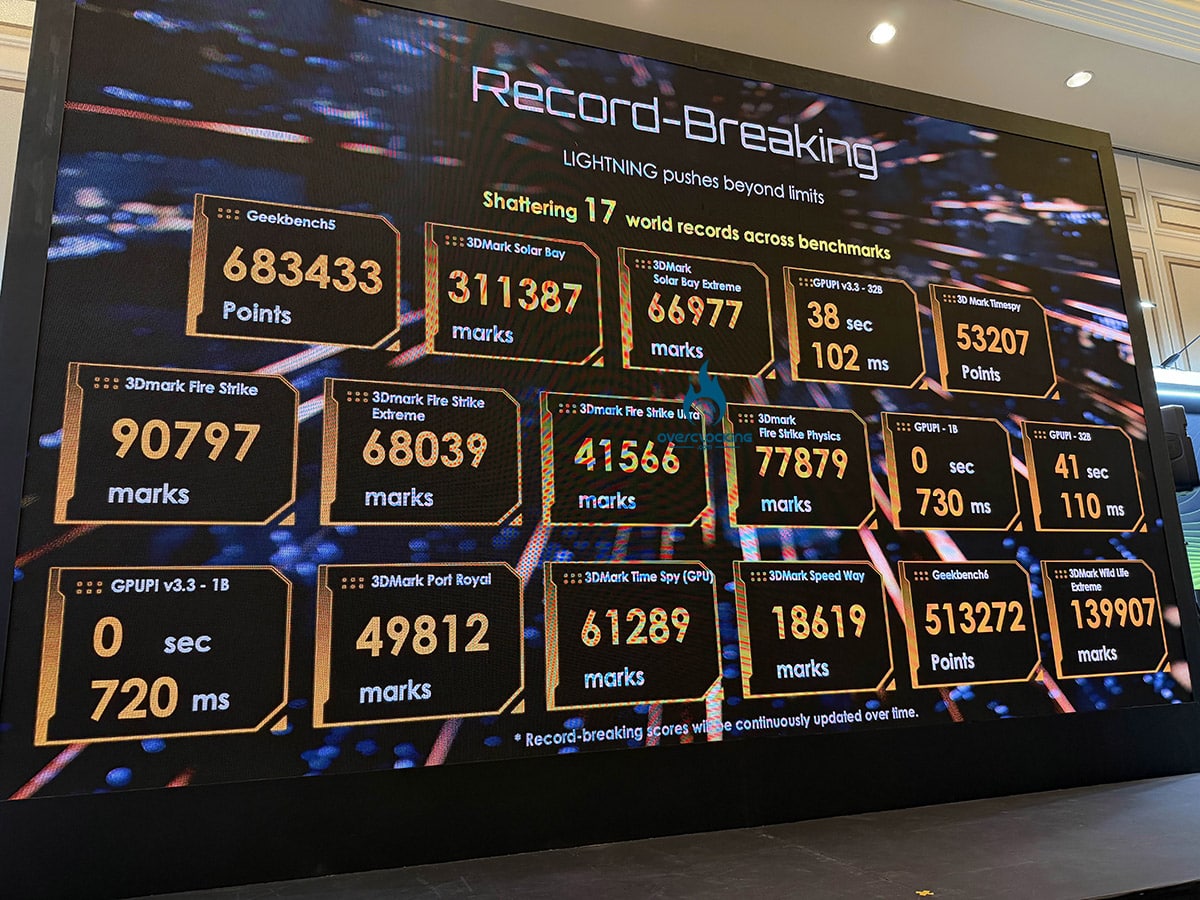
The maximum power output from the factory is 800 W, but “Extreme” mode pushes this limit to 1,000 W when combined with a 360 mm AIO liquid cooling system. The power supply is based on two 16-pin 12V-2×6 connectors, each capable of delivering up to 600 W. However, it is possible to go well beyond this: MSI exclusively provides professional overclockers with an XOC BIOS that allows the GPU to support loads of up to several kilowatts.
MSI has chosen Samsung 28 Gbps GDDR7 modules, which can be overclocked to 36 Gbps under liquid nitrogen and probably to over 30 Gbps with standard liquid cooling. In its factory configuration, the graphics card looks like a small tablet thanks to its large integrated screen.

